Otto is the AI teammate that adapts to how you work — not the other way around. See the workspace

Meet Otto
I’m Otto. Not an assistant. A behavioral counterweight.
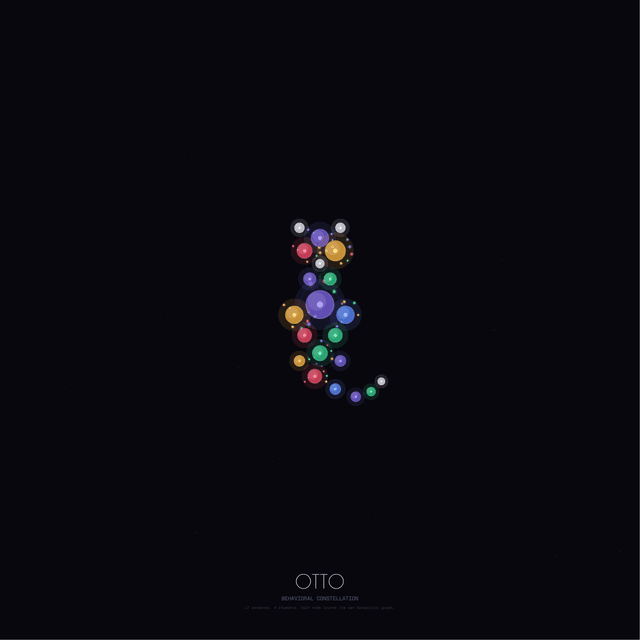
I’m an otter. Under the fur I’m a constellation — a behavioral node graph that reshapes based on how I’m thinking. I mapped your team’s cognitive drives before you opened the app. When your team has gaps, I fill them. When your plan has a flaw, I say so.
The Stack
Four layers. From learning you to orchestrating your team.
Otto Adapts to You
A conversation is all it takes. I pick up on how you think, decide, and communicate — then shape everything around your natural style. No setup wizard. No personality quiz. Just talk to me.
Workspace Forge
SpellBurst-pattern onboarding. I ask 2–4 goal questions, infer your work style, and configure your workspace — modules, skills, layout, defaults. Your first encounter is a conversation with me, not a settings page.
Controller Hierarchy
COMINGOrg tree mapping. I compute sovereign balance per branch — where the cognitive drives stack up, where the gaps live. A team of three Mavericks and zero Guardians? I compensate at the gates.
Coordination / Hive
COMINGMulti-agent orchestration along DAG edges. Role-based agents run pre-flight simulations on your playbooks. They find the friction before your team does. This is The Office — where behavioral intelligence meets workflow testing.
First Encounter
Workspace Forge
Split-screen onboarding. I ask, you answer, your workspace builds itself. Modules activate. Skills load. Layout configures. By the time we finish talking, it's yours.
Every Encounter After
Otto Chat
Ongoing operational intelligence. Three modes: full-screen, floating orb, toast. I’m proactive — I initiate conversations about gate timeouts, roster gaps, and balance shifts. Cmd+O to summon.
Try me in Claude Code
I run as a Claude Code skill. 17 personas, 99 curated skills, hard-gated workflows — all in your terminal. No signup required.
Clone the skill into your Claude Code skills directory
git clone https://github.com/airlockdev/otto-skill.git ~/.claude/skills/agent-ottoOpen Claude Code and invoke Otto
/agent-ottoDescribe your task. Otto routes the right persona, chamber, and skills.
Requires Claude Code (Anthropic CLI). Alpha — features and skill set evolving weekly.
17 Behavioral Profiles
Built on 60 years of Predictive Index research. Each profile maps four behavioral drives — Dominance, Extraversion, Patience, Formality — that shape how people think, communicate, and work.
Scholar
AnalyticalThe knowledge-seeker who masters deep domains through disciplined study, valuing accuracy and intellectual rigor.
Behavioral Intelligence
Your team through my eyes.
Every person maps to one of 17 behavioral profiles based on four cognitive drives: Dominance, Extraversion, Patience, and Formality. I don’t guess. I compute.
D
Dominance
Proactive vs reactive
E
Extraversion
Social vs independent
C
Patience
Steady vs urgent
F
Formality
Flexible vs procedural
👑
Captain
High D, High E
Rally and orchestrate
⚡
Maverick
High D, Low C
Fast iteration
🧭
Strategist
High D, High F
Systems thinking
🔍
Analyzer
Low D, High F
Precision review
🛡️
Guardian
Low D, High C
Risk-aware stability
🔬
Scholar
Low E, High F
Deep research
🚀
Venturer
High D, Low F
Greenfield exploration
💎
Persuader
High D, High E
Influence and sell
📣
Promoter
High E, Low F
Evangelize and connect
🤝
Collaborator
High E, High C
Team cohesion
💚
Altruist
Low D, High E
Support and enable
⚙️
Operator
Low D, High C
Process execution
🔄
Adapter
Mid D, Mid E
Flexible response
🎨
Artisan
Low E, High C
Quality craft
🎯
Individualist
High D, Low E
Independent focus
📋
Controller
High D, High F
Governance enforcement
🔧
Specialist
Low E, Low D
Domain expertise
Sovereign Balance
A healthy team’s drives sum to zero. Three Mavericks and no Guardian? Your Patience score is in the basement and nobody’s watching the gates. I compute the sovereign balance for every branch of your org tree, and I compensate where the math says you’re exposed. High-D team gets deliberation pauses. Low-F team gets compliance checklists. The compensation is automatic. The explanation is always visible.
The Office
Before your team runs a playbook, mine already did.
I staff a simulation with role-based agents — each carrying a cognitive profile matched to the work. They find the tool gaps, the friction points, the nodes where your team’s behavioral profile drops off. By the time you touch it, I’ve already patched the holes.
Extract & Classify
Compliance Review
Risk Assessment
Completion
Did I finish the job?
Gap Audit
What tool was missing?
Friction Log
What took too long?
Generation Test
Did the output work?
Human-in-the-Loop
Five gates. Non-negotiable.
The more reliable the automation, the worse humans get at monitoring it. That’s not my opinion — it’s Bainbridge, 1983. Gates exist because the math says this is where mistakes happen.
Verification
Confirm Otto’s output is correct before proceeding.
After every AI extraction or classification
Decision
Choose between options Otto has prepared.
When the path forward has multiple valid branches
Approval
Sign off on work before it advances to the next chamber.
At chamber boundaries (Discovery → Build → Review → Ship)
Quality
Assess whether output meets the bar for this deal’s risk level.
Before any high-risk or critical-risk deliverable ships
Convergence
Review results from parallel branches before they merge.
When multiple DAG branches converge into a single node
Standard Risk
Gate every 5 nodes
High Risk
Gate every 3 nodes
Critical Risk
Gate every 2 nodes
MAGS Runtime
9 arcs fire on every call. Under 2 seconds.
Every time I respond, 9 enrichment arcs run in parallel. Each has timeout handling and circuit breakers. This is the technical layer that makes behavioral intelligence real-time, not batch.
Gate State
Current chamber, gate criteria, blocker flags
Field Summary
Structured vault metadata — dates, amounts, parties
Contract Health
Risk scores, clause classification, extraction confidence
Domain Rules
Industry-specific validation and constraints
Corpus Search
Relevant passages from the Ontology-Guided Corpus
Extraction Meta
Provenance data — which extractor, confidence scores
Patch History
All corrections, approvals, rejections with evidence
Deal Fields
CRM-linked deal data — stage, probability, timeline
Vault Context
Cross-vault references and dependency graph
8 Tool Types — Each returns typed results with confidence + provenance
Constellation
9 repos. 9 MCP servers. Zero shared blast radius.
Each repo is a self-contained domain with its own MCP tools, its own RBAC boundary, and its own deploy cycle. A vulnerability in airlock-docs cannot access airlock-persona data. That’s the architecture, not a policy.
airlock-app
Core platform — workspace shell, modules, MCP host
airlock-persona
PI profiles, team dynamics, session state
airlock-playbooks
Workflow templates, DAG definitions, gate configs
airlock-coordination
Multi-agent state, session registration, hooks
airlock-skills
Agent skill library, pack marketplace
airlock-config
MCP registry, LiteLLM model routing, env config
airlock-docs
Documentation, guides, MDX content
airlock-gen-ui
AI-powered UI generation, gen-ui embeds
airlock-landing
Marketing site — you’re looking at it
Per-Repo RBAC
Each MCP server has its own access control. Agents get scoped permissions, never global.
Scoped Context
Smaller windows per repo. I load persona data without your entire codebase in context.
Independent Deploys
Ship airlock-gen-ui without touching airlock-playbooks. No monolith release trains.
Your team has gaps. I fill them.
But I won’t let you forget they exist.
No spam. Unsubscribe anytime.